Sunday, November 10, 2013

Vampire Squid, Vampyroteuthis infernalis

Its Latin name literally translates as 'vampire squid from hell'. It looks a bit creepy but that's not all it is a interesting animal. want to learn about it? It  is a small, deep-sea cephalopod found throughout the temperate and tropical oceans of the world. As a phylogenetic relict it is the only known surviving member of its order, first described and originally classified as an octopus in 1903 by German teuthologist Carl Chun, but later assigned to a new order together with several extinct taxa. As a phylogenetic relict it is the only known surviving member of its order, first described and originally classified as an octopus. The vampire squid reaches a maximum total length of around 30 cm.). Its 15-cm gelatinous body varies in color between velvety jet-black and pale reddish, depending on location and lighting conditions. A webbing of skin connects its eight arms, each lined with rows of fleshy spines or cirri; the inside of this "cloak" is black. Only the distal half (farthest from the body) of the arms have suckers. Its limpid, globular eyes, which appear red or blue, depending on lighting, are proportionately the largest in the animal kingdom at 2.5 cm in diameter. The animal's dark color, cloak-like webbing, and red eyes are what gave the vampire squid its name. look at the pictures the first one the fossil shows that it is very old species but it is not extinct. you can see the picture in the top right it is how it looks from underneath. The last picture is from the side. they look very cool to me.                                               


                                                please watch this video below:


 https://www.youtube.com/watch?feature=player_detailpage&v=X8oWnbcLI40


Saturday, November 9, 2013

Ghast

Ghast
 
 
A Ghast is a minecraft mob. It can be found in the nether unless you spawn it in. They shoot fire balls you can deflect it with any thing just by punching the fireball, try to air at the Ghast when you deflect the fire ball or it blows up a chunk of the area you are by and sets most of that place where it exploded on fire. Ghast are very large, jellyfish- or ghost-like mobs that float through the air and shoot fireballs from their mouths. They are lava and water resistant. Their bodies are 4 blocks tall and 4 blocks wide with 9 tentacle-like limbs hanging from the bottom and eerie-looking eyes. Even though the Ghast are dangerous and aggressive, they appear to be crying and have patches under their eyes which are actually tear stains. They first appeared in the Halloween. Ghasts are able to spawn above any non-transparent block in the Nether that is not in a nether fortress, as long as there is sufficient space (at least a 4*4*4 space, with the base centered above a solid block), and the difficulty is not Peaceful. They screech which is very annoying if you have volume on. Compared to other mobs, the Ghast has a very long search range and can target a player up to 100 blocks away. When the player comes within about sixteen blocks, the Ghast will open fire and attempt to gain altitude.Ghasts may drop a ghast tear when killed, but this can be hard to collect - because it is a flying mob, the tear may fall into lava or an inaccessible area. Ghast tears are a positive potion ingredient for Regeneration potions, and are very valuable on most servers with economies, so Ghast tears are well worth obtaining.


Ghast.png

Venus flytrap

                                                               "Venus flytrap"


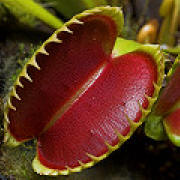
       The Venus flytrap is native to the bogs and swamplands of North and South Carolina. The Venus fly traps prey is limited to beetles, spiders and other crawling arthropods. Its normal diet is 33% ants, 30% spiders, 10% beetles, and 10% grasshoppers, with fewer than 5% flying insects. The lobe manufactures digestive juices and an antiseptic juice. This keeps the insect from decaying over the few days it is in the trap and purifies prey that it captures. The bugs can bite back!  In the springtime, the Venus Fly Trap can be killed by the very insects it eats.  Aphids can infect the plant and slowly kill it.  Also, grasshoppers and caterpillars can eat parts of the plant, but this is uncommon.  If one of these insects is bigger than a third of the size of the trap, it can cause severe leaf burn, stressing and killing it while the plant tries to devour it. Venus Fly Traps are health nuts.  If you feed it a hamburger, the protein and fat-based meat will rot the plant, eventually killing it.
Venus Fly Trap

Sunday, March 24, 2013

Spider jockey

                                                                 "Spider Jocky"


The spider jockey is a mob from minecraft.This creature is basically a skeleton riding a spider. When you kill one of them, the other one continues to attack you, making this combination very dangerous when encountered. They drop the same items as a  regular skeleton and spider. A spider has a 1% chance to spawn with a skeleton rider. This means that a spider spawner can very rarely spawn a spider jockey. Spiders spawned using Spawn Eggs in the Nether have a small chance(0.8% of the time) of a Wither Skeleton spawning on them. The spider controls the movement, so a Spider Jockey will wander aimlessly in the day and only pursue the player at night or in dimly lit areas when the spider is hunting. However, the skeleton will turn and fire at the player as soon as it sees them no matter the time of day When exposed to sunlight, the skeleton will burn and die like a normal skeleton, but the spider will remain active and deadly. Because a Spider Jockey can only spawn where an ordinary spider can, a spider-proofed area is also Spider Jockey-proof.
 
File:Spiderjockey-12w38b.png
File:Wither Skeleton Jockey.png

Spinosaurus

 
"Spinosaurus"


Spinosaurus (meaning "spine lizard") is a genus of the theropod dinosaur which lived in what is now North Africa and is from the Cretaceous period which is about 100 million years ago. This species was discovered in Egypt in 1912 and described by German paleontologist Ernst Stromer in 1915. The original remains were destroyed in World War II but additional bones have been found in recent years. It is unclear whether one or two species are represented in the fossils reported in the scientific literature. The best known species is S. aegyptiacus from Egypt, although a potential second species S. maroccanus has been recovered from Morocco.
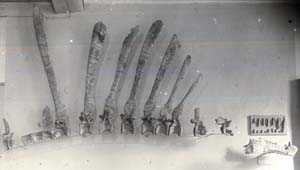
Spinosaurus may be the largest of all known carnivorous dinosaurs, even larger than Tyrannosaurus and Giganotosaurus. Estimates published in 2005 and 2007 suggest that it was 41 to 59 ft in length and 7 to 20.9 tonnes in weight. The skull of Spinosaurus was long and narrow like that of a modern crocodilian. Spinosaurus is thought to have eaten fish; evidence suggests that it lived both on land and in water like a modern crocodilian. The distinctive spines of Spinosaurus, which were long extensions of the vertebrae, grew to at least 5.4 ft long and were likely to have had skin connecting them, forming a sail-like structure, although some authors have suggested that the spines were covered in fat and formed a hump. Multiple functions have been put forward for this structure, including thermoregulation and display. Very few Spinosaurus fossils have been found, and they are incomplete. 

                            
                                 WATCH THIS VIDEO
 

One of the original Photographs of the Bones making up part of the “Sail” of Spinosaurus


                                    sources:      
1.http://en.wikipedia.org/wiki/Spinosaurus

2.http://www.enchantedlearning.com/subjects/dinosaurs/dinos/Spinosaurus.shtml
  3.http://blog.everythingdinosaur.co.uk/blog/_archives/2007/12/23/3426100.html


Sunday, November 25, 2012

Titanoboa

From deep underground in a Colombian coal mine, in a layer dating to 65 million years ago, scientists have uncovered remains of the largest snake in the world, Titanoboa cerrejonensis. Measuring 48 feet long and weighing in at 2,500 pounds, this massive predator could crush and devour a crocodile! Fossil plants and animals found at the site reveal the earliest known rain forest, teeming with life and dating to the Paleocene, the lost world that followed the demise of the dinosaurs. Featuring a full-scale model of Titanoboa and clips from a Smithsonian Channel documentary, the exhibition delves into the discovery, reconstruction, and implications of this enormous reptile.


sources: http://www.si.edu/Exhibitions/Details/Titanoboa-Monster-Snake-4820,

Sunday, November 11, 2012

Giant Squid

Giant squids can grow to a tremendous size. Recent estimates put the maximum size at 13 m (43 ft) for females and 10 m (33 ft) for males from caudal fin to the tip of the two long tentacles.  The arms and tentacles account for much of the squid's great length, making it much lighter than its chief predator, the sperm whale. It is common to find circular scars from the suckers on or close to the head of sperm whales that have attacked giant squid. Giant squid have small fins at the rear of their mantles used for locomotion. Like other cephalopods, they are propelled by jet – by pulling water into the mantle cavity, and pushing it through the siphon, in gentle, rhythmic pulses. They can also move quickly by expanding the cavity to fill it with water, then contracting muscles to jet water through the siphon. Giant squid breathe using two large gills inside the mantle cavity. The circulatory system is closed, which is a distinct characteristic of cephalopods. Like other squid, they contain dark ink used to deter predators. It also has the largest eyes of any living creature except perhaps colossal squid – over 30 cm (1 ft) in diameter. Adult giant squids' only known predators are sperm whales, but pilot whales may feed on them, also. Juveniles are preyed on by deep-sea sharks and other fish because sperm whales are skilled at locating giant squid. Scientists have tried to observe them to study the squid. Giant squid are very widespread, occurring in all of the world's oceans. They are usually found near continental and island slopes from the North Atlantic Ocean, especially Newfoundland, Norway, the northern British Isles, Spain and the oceanic islands of the Azores and Madeira, to the South Atlantic around southern Africa, the North Pacific around Japan, and the southwestern Pacific around New Zealand and Australia. Specimens are rare in tropical and polar latitudes.


Photo: Giant squid attacking bait squid

sorces: http://en.wikipedia.org/wiki/Giant_squid

watch 1. first then number 2.

1.https://www.youtube.com/watch?feature=player_detailpage&v=U2s3C0lkQE0

2. https://www.youtube.com/watch?feature=player_detailpage&v=NR53smpV_xg